

The 2025 Edinburgh Winter School on the topic of Teaching Programming across Disciplines was more than just an event. It was a gathering of 136 participants, 71 of which attended in person and 65 online, who are part of a vibrant community of instructors committed to breaking down barriers in tech education and challenging the status quo.
Grassroots of the winter school
Now in its second iteration, the winter school was born out of the interest of a group of University of Edinburgh academics interested in pair programming and to support the development of teaching-focused staff. Its members belong to many different departments, but now include colleagues from other institutions too.
Keynote highlights: feminist programming language and future-proofing education
Our keynote speakers and their stories touched our hearts and made our contribution as educators feel really meaningful!
Felienne Hermans gave an action-provoking talk on “A case for feminism in programming language design”. She challenged us to critically examine biases in computer science academia and tech education. We were also shown a fantastic live demo of the programming language that she created, Hedy, which gradually introduces users to its depth, while being multilingual and having teachability at its core.
Greg Wilson and Yanina Bellini Saibene (co-creators of the Software Carpentries) spoke to us about our favourite book, “Teaching Tech Together“. Their work embodies novel educational strategies of inclusivity, empathy, and humility—but we can’t believe these are still considered as “novel”… They also included a call to action for educators: by sharing teaching innovations, our students (i.e. the future educators) will experience the benefits of better teaching. This will help break a vicious cycle in that new educators are more likely to adopt better teaching strategies if they have themselves been exposed to it.
Long and short talks: realism and creativity in programming education
The event addressed equality, diversity and inclusion in programming education. Maeve Murphy Quinlan’s talk was particularly striking, highlighting the stark underrepresentation of women in tech, with just 17% of tech sector workers being women and only 9.5% of computer science A-level students being female. Her presentation was a call to action to dismantle unjust dynamics in digital skills education.
The lightning talks also showcased remarkable creativity of colleagues in programming education:
- Katie Muth introduced programming principles through poetry and cut-up crafts techniques
- Rhys Maredudd Davies explored culinary metaphors to build coding confidence
- David Cutting examined the power of metaphors in making complex programming concepts accessible
Key takeaways
Recurring principles and themes:
- Programming education must be inclusive and accessible in the widest meaning of these words
- Innovative teaching methods can break down complex technical concepts and make programming more approachable for students coming from less represented coding backgrounds
- Addressing equity is not optional; it is an essential step to equip traditionally underrepresented groups with skills that will help them in the job market and to future-proof society.
Feedback and impact
The attendees enjoyed the event, rating it 4.8 out of a 5-point Likert scale. The participants represented 59 different organisations (universities, start-ups, and government agencies) from 9 countries and 5 continents!
Below are some participant quotes:
Inspiring keynotes: “Key note talks were mind opening”
Community connection: “As a person not yet established in the computer science education community, it was very nice to see such a lively, diverse and welcoming crowd.”
Diverse learning experiences: “The lightning talks were really fantastic, there was the right amount and they were the right length. Great diversity of topics and general enthusiasm.”
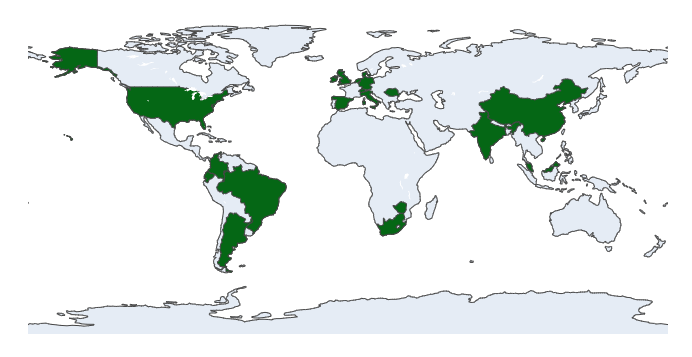
We couldn’t quite believe the representation of different countries at the event! The map below gives quite a good idea, with a country being shown in green if at least one participant represented that country.
Thank you
We must continue questioning outdated approaches to education and discuss ways to improve as society evolves, so please continue being innovative and inquisitive. We want to hear from your experiences and we look forward to have you join us again in the next (third) Edinburgh Winter School.
To everyone who took part in the 2025 edition (participants, speakers, organisers): thank you for your passion, creativity, and commitment to transforming programming education. Together, we are not just teaching code—we are building a more inclusive and equitable technological future.
Appendix: Winter School 2025 in numbers
In person: 99 Interested -> 89 Confirmed -> 71 Attended
Online: 77 Interested -> 65 Attended
Book Chapters: 48 book chapter suggestions
Stats: Who came to the Edinburgh Winter School: Teaching Programming across Disciplines?
Attendees: 136 people attended this one day event (71 in person, 65 online).
Countries: We had people from 19 different countries across 5 continents.
Organisations: 59 different organisations were represented (universities, start-ups and government agencies)
Departments: 48% of participants came from the University of Edinburgh (from 16 different institutes and departments including Music, Mathematics and Medicine)
Talks: 6 Long Talks, 16 Short Talks and 2 Keynote Talks.
Book: 48 Book chapter titles were were suggested on the day.